


Google Business Profile Optimization Tips to Improve Local Rankings

December 12, 2025 ~ By Shari Rose
Before search algorithms decided which local businesses appeared on our screens, we relied on word of mouth, physical proximity and community reputation to find necessary services. That discovery process is largely controlled by search engines today. When users are looking for the services of nearby businesses and nonprofits in their area, Google Business Profiles (GBP) serve as a primary gateway to that interaction.
As a result, service-based organizations and brick-and-mortar shops that serve local customers need conversion-driving, highly optimized GBP listings to successfully compete online. Directly influencing your website’s rankability in search engines, these profiles are foundational elements of Local SEO and not just another business directory profile to fill out.
The good news is that business owners and nonprofit managers can strengthen and optimize their Google Business Profiles without a professional’s help. With that in mind, we’ve prepared a practical guide for non-tech-savvy website owners to optimize their GBP through small improvements that can make a big impact in the long run.
How Google Business Profiles Determine Local Discovery
To quickly demystify some aspects of local search rankings, Google pays close attention to the intent behind every search made. It wants to figure out the “why” behind someone is using those specific keywords to find something.
A search for “landscaping” might result in national companies, how-to guides for homeowners and other general information. But “landscaping near me” or searching for “landscaper” from a smartphone triggers Google’s local search systems that are designed to connect people with relevant businesses that are physically nearby. This is where your GBP matters most.
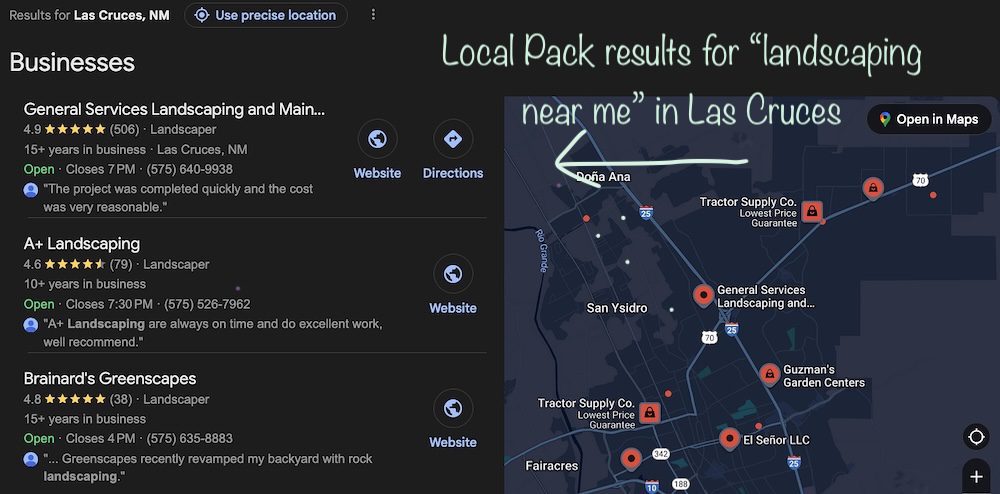
In search engine results, the Local Pack appears at the top of the page, displaying three businesses in a mapped format. This is the primest of prime real estate, and it typically attracts the highest number of organic clicks. The overall quality of your brand’s Google Business Profile is directly tied to its performance in the Local Pack and Maps results.
GBP Optimization Tips for Local Businesses
While some elements of SEO strategy are quite technical and require a specialist’s assistance, other areas truly are not. Optimizing your Google Business Profile takes a set of improvements that business owners can handle on their own.
Service Area
Google offers two approaches when choosing a service area. Radius-based says that you serve all markets with a defined number of miles. Specific area targeting allows you to list individual cities, neighborhoods and regions.
For a radius-based service area, resist the urge to claim an unrealistic swath of territory. An auto repair shop that claims to serve a 100-mile radius dilutes its relevance everywhere. Rather, determine where your most profitable customers tend to come from. If 85% of your revenue comes from within 15 miles, that narrowed radius will generate far better visibility among local prospects who are more likely to reach out.
Specific area targeting works well for brands that have a strategic geographic focus. A nonprofit serving three particular neighborhoods will have stronger rankability with those residents than a sweeping radius. Similarly, an accounting professional that works exclusively with businesses in certain commercial districts will benefit from that market optimization.
Business Description
Your business description should help Google understand your offerings while convincing nearby users to choose the brand. This is not the place for keyword stuffing or relying on an overly generic description.
To craft new descriptions or improve an existing one, it’s recommended to start with your value proposition in human terms. What problems do you solve? What makes your approach different from competitors? Then naturally optimize for a few keywords in the business description that customers or clients use when searching.
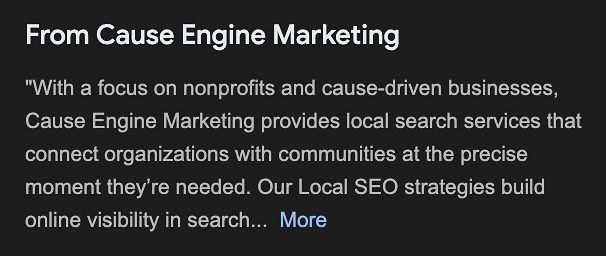
A financial advisor might write something like “We help small business owners plan for retirement through personalized investment strategies and tax planning.” This description includes keywords like “financial advisor,” “small business,” “retirement,” and “investment strategies” while staying authentic to its audience.
It’s tempting, but resist the urge to list out every possible service the organization provides. It’s far more effective to focus on the core parts of your business that local customers most commonly look for.
Photos
Images drive engagement on Google Business Profiles, and improving the quality of photos featured on your profile can produce a significant impact on conversion rates. A clean HVAC service van parked outside a home tells a more compelling story than the company’s storefront. A foodbank employee handing a bag of groceries to a young father creates stronger emotional responses than a banner image of the nonprofit’s logo.
Beyond the cover photo, subsequent images featured on your GBP naturally build trust by showing the environment customers will experience. Even businesses that make house calls benefit from a high-quality photo that shows employees at work at their headquarters or an office administrator answering the phone. These are behind-the-scenes looks that humanize your brand and build authority.
And corny though it may feel at the time, having the whole team pose for a photo is an underrated but deeply effective way of breaking the ice with prospective buyers and building trust before they even click on your website.
Reviews
Social proof is king in Local SEO. As AI-generated content and bot-driven engagement makes it harder and harder to trust what we see with our eyes on the internet, authentic reviews on Google Business Profiles are worth their weight in gold. According to a 2025 BrightLocal survey on consumer behavior, 83% of respondents use Google to find local business reviews.
If you don’t have many reviews on your GBP, or the ones you do have are becoming outdated, it’s time to ask your satisfied clients or customers to leave a testimonial. This is a key optimization strategy. Whether it’s a verbal ask or a quick follow-up email with a link to your Google Business Profile, happy customers drive future business through their honest feedback. In your account, you can copy a shortlink to your profile by clicking the “Share” button seen below.

If possible, connect that satisfied client directly with the employee who assisted them. The friendly contractor who fixed their roof two days ago is far more likely to convince a client to leave a public review than the office administrator who never met them.
And positive or negative, it’s important to respond to reviews on your Google Business Profile because local audiences will be reading those too. When writing a response, try to avoid generic and short catch-alls like “It’s our pleasure to help” or “Thanks for the kind review.” Instead, include some specific or personalized details such as “We’re glad Tony was able to quickly resolve your emergency plumbing issue and avoid potential flooding.”
Categories
The primary category of your GBP is a fundamental definition of your brand. Google provides thousands of specific categories, and making the right choice has implications for the overall rankability of your profile. You’ll want to aim for a primary category that is best aligned with your business goals and the actual services you provide.
There are also secondary categories to consider. These give the option of further optimizing your brand or highlighting a particular service you want to perform more often. For example, a dental office may choose the primary category of “Dentist” and add “Dental implants provider” as a secondary category for its Google Business Profile.
Every situation is different, but it’s generally recommended to avoid broad categorization. A local nonprofit offering multiple services might be tempted toward marketing themselves more broadly, but “Environmental protection organization” connects with audiences more effectively than “Non-Profit Organization.”
Questions & Answers
An often underutilized element of Google Business Profiles is the Questions & Answers section, but it’s a useful way of addressing concerns early and improving brand credibility. What are common questions that arise in early conversations? What misconceptions may people have about your industry?
Getting ahead of these questions can save your sales team some time on the phone and plus, it’s a more subtle GBP optimization technique for including a couple high-quality keywords in your answers to boot.